In 2006 I was fifteen years old and in fourth year at high school. To my own surprise, English had become one of my favourite subjects and one that I was keen to actually apply myself to. I liked being given a poem not knowing what it meant then breaking it down line by line to reveal its meaning like a secret message in a painting. I also liked that we just got to sit and quietly read a book in the middle of a busy day. And I liked that we got to write ‘expressive essays’ in which my burgeoning poet’s heart got a chance to flap its teeny-weeny wings. Fired up on prime noughties emo ballads and Maoams I wrote the following reflective essay, to which I’ve interspersed some notes and critiques throughout. Okay – I’m basically roasting the work of a fifteen year old who’s trying their best, but it’s okay because who I’m roasting is me.
Two streets down from my house sat a gathering of winding sleepy trees that would be known to me and neighbouring friends simply as “The Woods”, which had been a generous provider of entertainment and excitement for at least five adolescent grass-stained years. Where the only limitations were how much trouble you would get in for ruining a perfectly good pair of trousers, and of course, being home for tea.
I quite like the phrase “sleepy trees” because despite being the person that wrote it, I have no idea what it’s supposed to mean. When I imagine “tree” in my mind’s eye and then I add the quality of “sleepiness” to it, it just stays a tree. What will soon become evident was an ardent belief that every noun can be made better with an adjective before it so get ready for a fair whack of that. Also, where I’m from we’d use “tea” to mean “dinner”. I don’t know why. It’s especially confusing considering everyone we knew also drank tea. I was around twenty years old when I learned that this wasn’t universal parlance.
Days would be spent in adrenaline fuelled states where actions didn’t lead to consequences, but only lead to more actions. These bursts of renewed energy would be put into efficient use by making sure our base was properly fortified with grass and sticks to defend our sanctuary from invaders who didn’t exist. This place was unlikely to be politely disturbed by anyone, despite being invaded, which we knew.
Oh dear – it looks like I didn’t quite grasp how to use the word “despite”. Bless my English teacher for either understanding what I’d intended it to mean or for thinking that our base actually was a regular target of urban guérilla warfare. “Let alone” or “nevermind” would have done the job but what’s important is that you tried.
These days were dominated with bright blues and greens that shielded us from any facts or truths about what was happening in the rest of the world. In this haven the only matters that concerned us were the only matters in front of us, which never exceeded the emotional or thought provoking requirements needed to process how likely you would be to hurt yourself by jumping from certain trees.
I remember writing that last sentence, sitting in front of my PC’s heaving CRT monitor, absolutely labouring over it. I knew I had a half-decent notion but I must have rewritten that sentence thirty times, trying to be a right wee smarty-pants. I like that in an assignment about reflection and emotional insight I used the words “exceeded”, “requirements” and “process” in a single sentence, sounding like a robot trying to write poetry.
Time took its course and the adventurers and I slowly began to grow up, and as things started to become important less and less time was spent in The Woods not knowing these things existed. The less time we spent falling over and getting muddy the more real other things became, and this persisted until the woods were no longer a place of refuge from reality, but a memory of a much simpler time. Although this evolution wasn’t what any of us wanted, we knew it was relevant and nothing could be done to reverse these effects as life became more and more real.
The usage of “real” is an interesting choice in this context. We get it – life starts to become more serious, intense and hard-work as you progress through high school. But what is “real” determines your sense of reality. All this reality that The Woods were able to deflect makes it seem like some kind of neurological protective trauma response. They were just trees that we used to play in – not some reality-resistant Salvador Dali painting we could climb into.
By thirteen years old The Woods had become like an old relative whose company you savour in the rare occasions of an encounter. There was no longer an excuse to go there as we were too old and had systematically been made to think about, and plan the rest of our lives, this was until I started first year at high school. The Woods led to a field which took you straight to High School, and though walking this path didn’t renew your energy or grant any relief from pressures of reality as it used to, every morning it would serve as a reminder to the purity and innocence that lingers behind the often overwhelming stresses of day-to-day life. Although our trousers remained clean and our bodies free of bumps and bruises, just the presence of The Wood kept its simple concepts alive.
The struggle to deal with reality emerges again here. No wonder I got into D&D as an adult. “Although our trousers remained clean” sounds a lot like I’m bragging about me and my friends not soiling ourselves. Perhaps another moment of foreshadowing considering I went on to be diagnosed with Crohn’s Disease.
Through first, to fourth year at high school I could walk into school with a subconscious sense of optimism constantly present in my mind as every morning I would walk past The Woods and would be reminded of everything that is right in the world.
Apparently at fifteen I had full awareness of my subconscious functioning. Wish I still had that. Also, I don’t know if that silly wee comma there was the result of an accidental keyboard bash but it was there in the original and there it’ll stay.
A few weeks ago, my outlook on the world was shaken as news of a new building construction was brought to my attention. The Woods were to be destroyed, the ground to be flattened and be filled with concrete, ready for a new block of flats to be built upon this haven. Optimism was a hard thing to come by for the next few weeks as a constant pulse of industrialism pumped out more and more trucks and workers and diggers past my window.
In fairness, I actually quite like the ‘pulse and pump of industrialism’ line. But I can’t get over the image of my fifteen year old self, who’s primary concerns were rollerblading and MySpace, finding optimism hard to come by. Maybe too much My Chemical Romance will do that.
I let a few weeks pass; trying to find solace in other natural wonders but none could provide the same sense of hopeful optimism, until yesterday, when I decided that I would visit the remains. I reached the end of the second street and my eyes met directly with the corner leading into The Woods, the radiant glow the bright green would reflect had dulled as sprays of loose dug up soil had smothered its hopeful shine. I kept on walking until I reached the grass where I was in plain view of where The Woods had once stood. Hopeful bright blues and greens had been replaced by cold greys and browns of concrete and mud. Wire fences had been put up because of the construction of the new road being built, and out of all the places in the world to put up metal fencing, I believed this place was the last I would ever like to see it. All of the trees had completely disappeared and had been replaced by a tall wooden fence layered in logos and posters from the construction companies. This extreme oxymoron created a strong feeling of loss and disappointment inside of me, my childhood memories and source of hopeful attitude had been torn down and replaced by fences, limitations and advertisements. The irony of the situation became too much for me and I made my way back home, pondering how I could ever retain my optimism, when I spotted in the corner of my eye what looked like an oddly shaped stick. Upon looking closer I discovered that it was the skeleton of a bird, lying on a patch of dead grass. This forced me to pause and reflect as I have never experienced such a symbolic event such as that in my entire life.
This may be my favourite section. The real meat and potatoes. If you want your English teacher to know that you’ve learned what an oxymoron is and that you get symbolism, just straight up tell them! I also like that the oxymoron isn’t just an oxymoron, it’s “extreme”. Perhaps like I was on my rollerblades. Imagine a regular oxymoron but it’s doing a 540 over a funbox – I think that’s what I was going for. The bird’s skeleton was actually a nice touch, if only I’d had the belief that my teacher would just recognise the symbolism, rather than feel like I had to explain it with all the subtlety of a dump truck. I evidently hadn’t learned the show-don’t-tell rule yet. I seemed to prefer show-then-tell-then-explain-like-they-are-stupid.
I returned to my Dad’s house without much to say and a lot to think. I packed up my school things and left for my Mum’s new flat by the sea.
I sure had a lot to think about! Like how extreme oxymorons can be and how frustrating it is to have to explain symbolism all the time. Here I also introduce a subtle bit of world-building while completely missing an open goal – the backdrop of divorce. This would have actually been something substantial to anchor all the angsty reality-denial on. Unfortunately I was so unperturbed by the whole process that it didn’t occur to me to include it in a REFLECTIVE essay. I’m about as reflective here as all that construction mud I mentioned earlier.
As I walked down the seaside road lost in my thoughts several shimmering lights caught my eye, I turned my head to them to witness the moon and all the lights of Edinburgh reflect off the tranquil waters of the Forth. For the second time in one day I had stopped in my tracks, this time for a different reason. The view took my breath away and in one swift thought the emotional support I had lost from The Woods was reinforced. This may not be the same place where you could run and jump and climb and fall but the same overwhelming sense of freedom was still present in the beauty of the lights dancing upon the waves, in the way the trees twirled and stretched towards the sun.
I thought the trees were sleepy – now they twirl and stretch towards the sun! Tree indecision aside, I quite like this bit too.
The adventurers had gone their separate ways, and the flats are being built, but I take comfort in knowing that no one can take the sea and the moon and the stars, and the memories of bright greens and blues.
Richard McAllister, S4
D’aww. Despite all of the clunky sentences and weird descriptions, I think fifteen year old me did pretty well overall! There’s some nice nostalgia-jingling imagery and themes that I still jive with – finding peace in nature, finding solace in the protection of memories and coping with the ever-changing march of life.
It’s a funny ol’ age; fifteen. Old enough to not feel like a child anymore but too young for any meaningful autonomy. Isn’t it funny that in attempting to sound sophisticated and grown-up, this little guy ends up doing the opposite. I suppose what he didn’t consider is that being grown-up is defined by life experience that you can’t fake, no matter how many adjectives you’re willing to sling around. Reading this back now, twenty years later, paints such a clear picture of a young fella desperately wanting to appear grown-up with an accompanying deep and complex internal world. I think if I was being really honest at the time of writing, I was more likely to find peace looking at a starry sky in Azeroth than looking at one in real life.
Regardless of its questionable quality and honesty, this piece was still important to me. I distinctly remember getting the essay back from my teacher and was astonished to see a high score and a note that said “best thing I’ve read this year”. It was the highest compliment a teacher ever gave me. I still vividly remember reading it and the accompanying smile from the teacher. Some family members got hold of it too and also shared their praises, something I’d never really experienced before then. I don’t doubt that the rare encouragement helped to incubate an interest in creative writing so I’d always considered the piece a bit of a turning point. It was perhaps the first time where I had people older than me say “hey – you’re not half bad at this” and at the time that meant the world. Until recently I thought that this piece was long gone in the way that all childhood drawings, paintings or hand-written stories seem to. So I have to thank my Dad who came across two crumpled sheets of A4 in his choc-a-bloc garage that just so happened to be this piece.
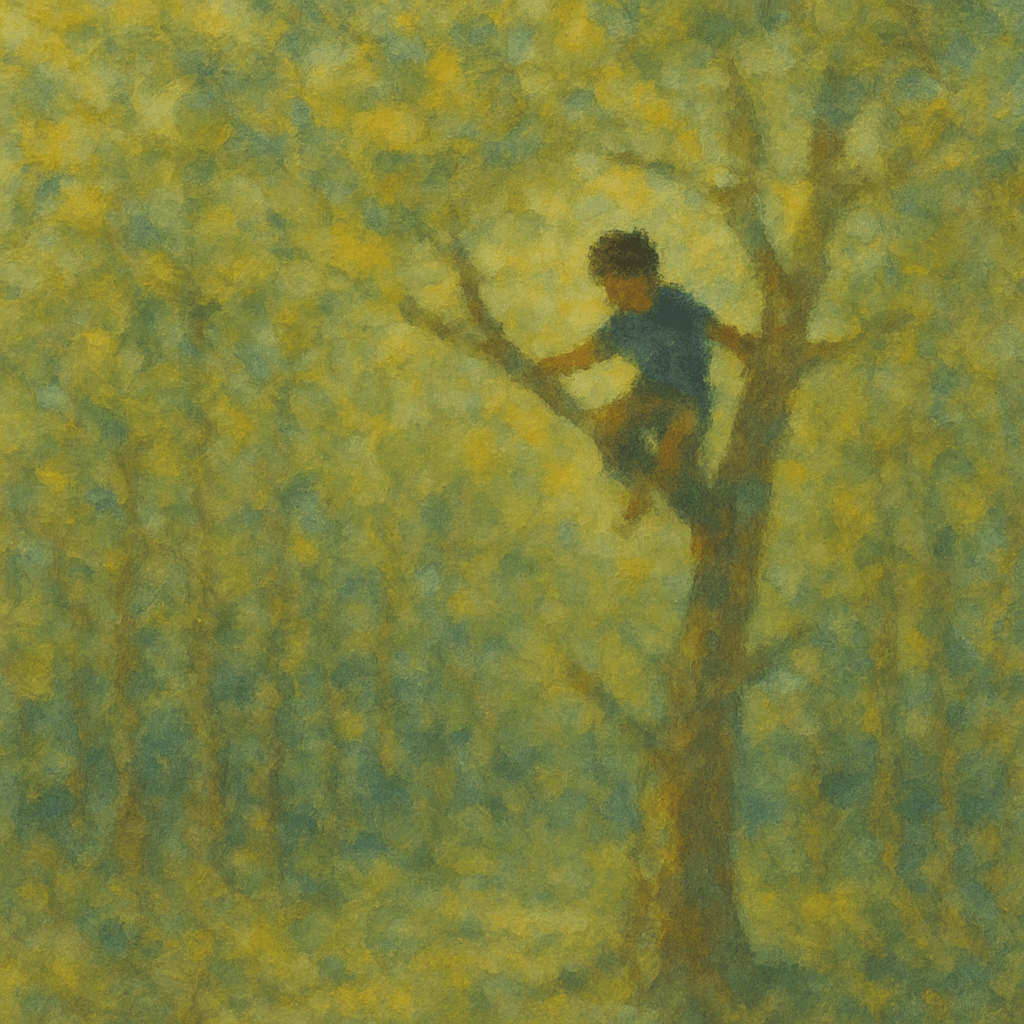
So what are my main take-aways from looking back and reflecting on my reflective essay? Well, I feel a lot of warmth for that little scallywag. He’s naive and romantic and is playing pretend at being what he thinks he’d like to be. Which in fairness, is a pretty good way to become whatever it is you’d like to be. Unfortunately for him, you can’t expedite growing up and you don’t know what you don’t know. I feel his impatience to sit at the adult table but want to warn him that it’s mostly boring conversation and that wine isn’t as tasty as it looks. Isn’t it cruel that we spend our youth chasing after independence to then laterally crave the freedom of our youth? The kids table is where the living really happens. I often get this eery feeling when you look at old photos or videos or in this case an essay, because that young person doesn’t exist in the world anymore. That child is no more. In his wake is an older guy who looks a bit like him and sounds a bit like him but ultimately is not him. It gives me a bit of reprieve to imagine him residing in my head somewhere memories live and he’s climbing a tree on a nice day, he’s wearing tattered tracksuit bottoms and is getting ready to do a big jump to try to impress his friends. That wee dude changed a lot over the next twenty years and things definitely became more “real” but I can happily say that I think he’d like who he became. Because at the very least, I really enjoy looking at the moon and the stars.
 WORDGOBLIN
Leave a comment