
Peter Hardy owned a jewellery shop just off the high street. He liked owning a jewellery shop, for the most part. Cresting his mid fifties, he wore shiny brown shoes and pastel jumpers with a shirt underneath so the crisp collar poked out. Cosy but professional, he felt. Every morning, before opening, he’d lint roll himself in the storeroom mirror, smooth down his clothes and then look up at the framed photo of his father on opening day. Inside he’d reaffirm his will to do him proud. Not that he felt that that was truly possible. He had always been notoriously hard to please. And presently dead. But he’d try anyway because he said he would. So he smiled at everyone who came in and did his best to help customers find something special. He liked it enough. It was, by his estimations, fine.
It was a Thursday. Peter liked Thursdays the best. A flutter of excitement lived deep in his breadbasket on Thursdays, not that he’d let it show. He was helping an elderly woman pick out a bracelet for her granddaughter’s birthday when the doorbell chimed. He looked to the locked door and then to his watch. 1.45pm. The same time he always comes. He smoothed down his jumper and cleared his throat, “sorry Norma – mind if I get the door? Won’t be a moment.”
“Oh no, of course not, lovey.” Said Norma, as she went back to staring at the same three bracelets she’d been staring at for nearly thirty-five minutes.
Peter unlocked the door and welcomed in a man sensibly dressed in a thick Tweed coat, smart black shoes and wireframed glasses, perhaps in his fifties, if he had to guess, which he didn’t.
“Hi there, I’ll be with you shortly. Just have this customer to finish up first. But feel free to have a look around.” Peter said.
“Oh yes yes, of course.” Replied the man in Tweed.
There was a pause between the two men where their eye contact held. An extra fraction of a heartbeat. A barely perceptible sliver of time. Not another soul could have detected it. Yet Peter’s excitement was suspended entirely within it. But first – Norma. With some further assistance she settled on a thick sterling silver chain link bracelet which Peter thought was, he supposed, nice enough. He found a suitable box and gift bag, packed up the bracelet and then, not unhurryingly, escorted her to the door.
“I’m sure your granddaughter is going to be delighted.” He said, silently acknowledging that he had no way of knowing that. The door’s lock clicked closed behind her. He turned to see the man in Tweed peering into a cabinet of early 20th century rings. Peter suppressed a smile, straightened his collar and brushed down his jumper.
“Looking for anything in particular today, sir?” Peter asked.
The man in Tweed looked to him and nodded then back to the rings. “Well, a few of these have certainly caught my eye.” He replied.
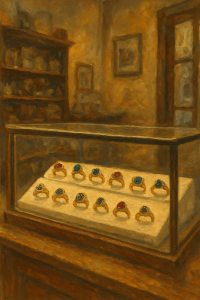
“Ah, then you’ve got a fine eye for quality. These are some of our most rare pieces.” Peter stood up a little taller than usual, moved behind the counter with a little more grace than usual and opened the glass cabinet where the rings were kept on display. He removed the display shelf and placed it on the counter. Peter invited the man in Tweed to choose one with a flourishing sweep of his hands over the rings. The man’s eyebrows lifted like rigged theatre scenery and he nodded, seemingly further impressed at the jewellery up close. His hand hovered in circles over the rings. He picked one up.
“Mmm, yes. Very nice.” Said Peter. “1920s. Pearcut amethyst. Try it on.”
The man slipped it on his chubby pinky and held it out appraisingly, eyes squinting behind his wireframe glasses. “Very fine. Very fine indeed.” He said, his deep voice almost a whisper.
Peter’s whisper echoed, “Very fine indeed.” A hint of propriety coloured the edges of his normal speaking voice. He selected another ring and presented it on his flat palm, his free hand revealing it like a curtain. “A pink sapphire and diamond cluster. Set in 18 carat white gold. 1910s.” The man in Tweed eyed it and nodded slowly before picking it up and putting it on his other chubby pinky.
“Mmm, yes, yes.” He said.
“Mmm, yes.” Peter said.
Peter went under the counter and produced another tray of rings. He popped one on his middle finger and with a pleased raised brow, flaunted it to the man in Tweed.
“Oh, very nice, yes. Very fancy.” Said the man in Tweed.
“Mmm, yes.” Said Peter, eyelids half-dropped, mouth downturned, voice beginning to sound like a cartoon butler. “A fancy ring for a fancy man.”
“A very fancy man.” Said the man in Tweed loudly as he slipped on another couple of rings on each hand.
Peter did the same and asked “Pray tell me, good sir – have you always been such a fancy man?”
The man in Tweed wiggled his fingers in front of his face, rings clinking together. “A fancy man, you say?” He laughed a regal gaffaw. “Perhaps fancier than some. Not so fancy as others.” He looked Peter up and down on the last word, one eyebrow raised like a pantomime villain.
“Mmm, to that we can agree.” Peter rolled his Rs like an Edwardian countess. Peter and the man in Tweed were now wearing 2-3 rings on each finger, hands laden with thousands of pounds of shining gemstones.
“Quite fetching, my liege.” Said Peter, bowing his head.
“Why thank you, my liege.” Replied the man in Tweed, bowing his head.
“But for a fancy man such as yourself, I daresay perhaps this is more fitting.” Peter produced a glittering tiara from a display unit.
And on it went. Peter and the man in Tweed had adorned themselves with handfuls of antique rings, bracelets and necklaces each. They marched importantly around the small store, their tiara’s glinting in the afternoon sunlight. Occasionally they’d stop to point at the jewellery to say “mmm very fancy”. Occasionally they would bow and curtsy to each other and say “my liege”. This thing – this was what they did on Thursdays.
After fifteen minutes or so the man in Tweed stopped and rolled up his sleeve. Moving four bracelets aside he looked at his watch. His shoulders dropped as he sighed a heavy breath out. Then quietly he began to remove the jewellery, each one clinking against the glass countertop as he gently placed them down. Peter realised what he was doing and knowing their time had ended he began also removing the jewellery he’d put on, replenishing his display shelves. The man in Tweed took the tiara from his head and placed it on the counter. He stared deeply into it for a moment and then without so much as a word, he turned and left the shop. The door’s lock clicked behind him.
Peter finished putting away the jewellery, sighed and smoothed down his clothes. He fought the urge to look at the photo of his father on the wall. Seven days felt very far away. But come 1.45pm next week, he’d get to do it all over again. He felt a tiny bit of excitement already at the thought. Peter liked Thursdays the best.
 WORDGOBLIN
Leave a comment