This year we commemorate the 50th anniversary of one of the most enigmatic works of contemporary Scottish poetry; a publication that changed the landscape of Scottish literature. Highland Publishing House is proud to announce the Special Anniversary Edition of Thomas Allen’s seminal anthology –
The Collected Works of Bogman
As discovered by Thomas Allen
The limited edition hardback will feature brand new cover art designed with gold embossed lettering, a decorative “In the bog!” leather bookmark and new foreword by poet laureate, Professor Simon Pickwell. Most excitingly, this edition includes a 74-page central plate section of never-before-seen high-resolution scans of the original poems, providing the world its first glimpse of the poems as Allen discovered them.
Pre-orders available via our website. Limited to 5,000 copies.
(Signed editions available pending condition of author’s arthritis)
To celebrate the launch we are delighted to share an exclusive rollercoaster interview with the enigmatic author, marking his first official public interview since the publication of his 1997 follow-up memoir; Life Beyond The Bog. In the interview, conducted by our in-house Bogman specialist; Jessica Bisset (Senior Editor, Highland Publishing House), they discuss the strange events that led to the creation and discovery of Bogman’s poetry, the secrets they possess and the controversies that still surround the mystery to this day. We invite you all to delve into the bog with us and celebrate the legacy left by a being of whom we know almost nothing about. Nothing besides a name – Bogman.
#19
Sometimes Bogman
Sees the stars
And wonders
Is the sky a blanket
Hugging earth
Lucky earth
To be held
By such a blanket
Sometimes Bogman
Wishes to be held
By something
that wasn’t bog
Sometimes Bogman
Wishes he had a blanket
Made from stars
Not moss
The Interview
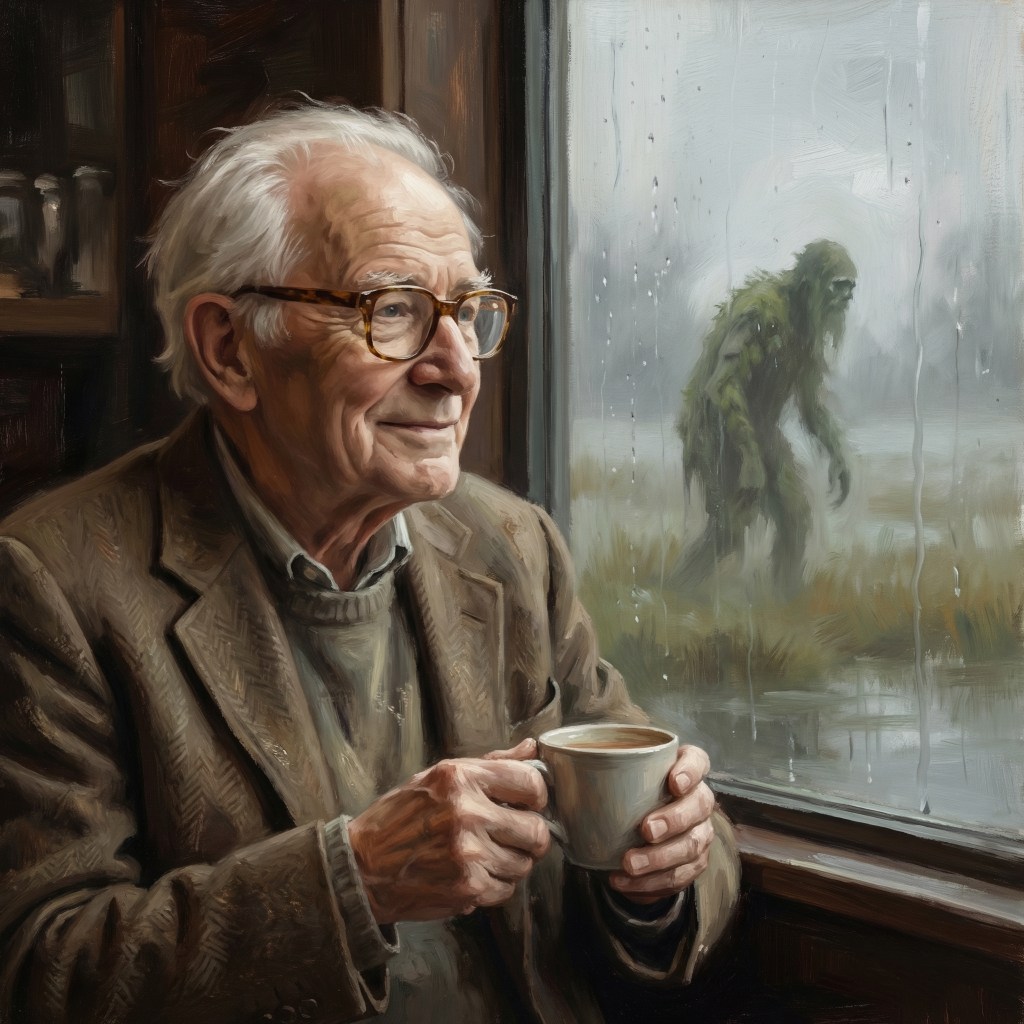
I await Thomas Allen in a service station Costa just off the A9; a small and unsuspecting place he’ll later describe to me as “one of the finest establishments in the land”. When he enters, twenty-eight minutes past our agreed meeting time, I take a moment to observe the man we all know, yet know so little about. He adjusts thick-rimmed tortoise shell glasses, undoes his belt and tightens it a notch then with an out-stretched finger he scans the tables, presumably, for me. I watch as he approaches a woman breastfeeding her baby and ask loudly “are you the magazine lady? From the email?” She shields her child and declines. At this point I stand and call his name and watch relief soften his wrinkled face, giving way to a warm, unabashed smile. He points at the mother and shouts across the Costa to me; “I thought she was you!” He chuckles quietly and we meet for the first time, accompanied by the backing track of a crying baby. He wears mustard cords and a grey-brown woolen jumper with a crusted smear down the sternum that I later suspect was either potato or lentil soup. After a brief introduction, in which he told me his name and didn’t ask mine, he excuses himself and makes his way to the counter, his wispy lengths of white hair lagging behind his head like a poltergeist. I couldn’t help but listen as he politely ordered a cup of tea, a ham and cheese toastie, a tomato and cheese toastie and a tuna melt panini. He pays with a £50 note, holds up a hand to refuse the change and says “thank you, dear” to the ponytailed young man serving him. He drops into the chair opposite me with an exhalation like an empty hot water bottle being punched. I open my notebook and look at my questions.
JB: Hello, Thomas. I’d like to thank you for doing this today, from me personally but also from the many many lovers of Bogman’s work – work that, without you, would have never seen the light of day.
TA: Yes, well, that’s fine.
JB: Oh and my name’s Jess, by the way. It’s truly wonderful to meet you.
TA: Yes, hello. It’s going to rain, I reckon.
JB: Yeah. Yeah, it looks like it might. Anyway, before we get too deep into your story surrounding Bogman and his poetry, could you just tell us how it feels to be reaching this milestone? How does it feel to have had these poems – poems that you discovered and brought to the world – touch the lives of millions of people over the span of 50 years?
TA: Fifty years, is it? Good heavens. That’s quite a long time, isn’t it? I suppose I was just a young man back then, when it all began. Barely a man-grown. Not but a buck with a head full of stories. Oh I was a strong lad though. Bookish yes, but strong as a bull. You wouldn’t think to look at the plump old fellow before you now but don’t be deceived – I’ve still got it, you know. I could pick up this table if I wanted to. Would you like me to?
JB: No, that’s okay.
TA: Perhaps later?
JB: Perhaps later! But the poems – how would you say they have defined the last fifty years of your life?
TA: Fifty years, fifty years…how cruel; the march of time. I really had no idea how things would turn out, you know. I couldn’t possibly have anticipated the success of the book. And to think of all the people that have taken such joy from it! I’ve come to find great pleasure in that. Even if the work was not my own doing. The creative endeavour is one thing, a magical thing, but cannot there be pride too, in stewardship?
JB: I would certainly say so.
TA: Yes, yes, I may not have been the one who produced the treasure but it seemed my destiny was to be the ship that brought it back to shore. A sturdy vessel. Steadfast. Yes, the ship…
His last few words come out as a whisper and his attention drifts leaving him staring wistfully out the window over a greying carpark. He quietly repeats a few more times to himself, “the ship…the ship…the ship…” until a pot of tea is placed down in front of him and breaks his trance. He stares at it blankly before recalling having ordered it and asks for an extra pot of milk. When the ponytailed barista returns with it, Thomas tips him with a £50 note from his pocket and says “thanking you, dear.” The barista fails to hide their delight before slipping the note in their apron pocket and heading back behind the counter. Thomas pours his tea with a gently trembling hand that I notice has reminders written on the back – “milk, eggs, magazine lady.”
#8
It seems to Bogman
That this little flower
Is made
from a hundred
Little bits
And the little bits
Become littler bits
When they are further pulled apart
Two hundred three hundred
Little bits
Maybe even more
This flower is too much
To count
But not too much
To enjoy
JB: So Thomas, could you tell us about your first encounter with Bogman? How did your relationship begin?
TA: Well, I’m not sure you could qualify what we had as a relationship. That would suggest a sense of mutual association. I’m not sure he ever truly knew I existed, sad as that is to admit. But yes, well, it was late spring, 1973. What I really wanted to do was to write, you see. To be an author and poet. T’was a silly daydream, of course – but one I pursued nonetheless. So I saved up my salary over a few months and with it I bought a nice little cottage outside Kinloch Rannoch – a nice rural place where I wouldn’t be disturbed. I had enough left in the coffers to keep myself afloat while I worked on my writing for around a year or two.
JB: Wow, that sounds like every writer’s dream! I know I’d kill for that kind of set up. You must have squirreled away quite a savings pot. Do you mind if I ask what your previous job was?
TA: I was a milkman.
JB: A milkman?
TA: A milkman. I drove a milk float and I delivered milk. That surprises you, does it?
JB: I suppose it does. You just don’t hear about them so much these days.
TA: That’s because back in those days we all knew the importance of good dairy, you see. It made you robust. Hardy. Not like now, what with all the allergies and strangeness in the youth. Tell me, what are you drinking?
JB: A soymilk latte.
TA: I have no idea what that is. What’s it made from?
JB: Soybeans.
TA: My point exactly! A bean?! What an absurdity, to drink a bean. Yes, back then everyone wanted a bottle of cow’s milk on your doorstep, each morning. Cold and fresh. Well, not fresh but you know – pasteurised, at the least. Anyway, stop talking about milk, you silly thing. It’s neither here nor there.
JB: I only asked because-
TA: Now, what’s important is that I’d be writing away in my cottage and I’d hit a spot of writer’s block. As it goes. So I’d pack a rucksack and go for a long walk on Rannoch Moor to clear my head. A very lovely area but very damp. Very boggy. Sodden. I always – ALWAYS – brought a spare pair of socks along with a few sandwiches. I had a favourite route that took me through a forest and out into peatland bog. There was a boulder overlooking the bog with a nicely eroded bum-recess where I’d sit and think about my writing problems over a sandwich. Ah I remember it so vividly. Clear as a spring day. I took a bite – mature cheddar on heavily buttered brown – and then I saw him.
#43
Sometimes little flower buds
Will pop out of the moss
Leaving Bogman
Left to wonder
From which moss
Did he pop
JB: Could you describe what you saw and how that felt?
TA: Originally I thought it must be a doe, wandered carelessly into the bog. Poor thing, I remember thinking. It was far off in the distance, you see. Perhaps 150 feet away. Then I noticed the figure didn’t move like a deer. It was bipedal. Upright, though hunched. It seemed to be rooting around in the water. My intrigue turned to horror as I imagined a monster – some foul beast of the bog. But no, no, that would be ridiculous – so I got closer. I reached perhaps 80 feet away when his head turned and he saw me. I froze. He froze. And for a time we were still. Two insects suspended in amber. Staring as though each other were a puzzle beyond comprehension. Eventually I raised my hand to wave and it must have spooked him. He startled, turned and waded away through the muck, making a faint whooping cry as he went. On occasion, if I’m lucky, I will hear it in my dreams. A kind of, a-hoo-hoo!
JB: That’s incredible. Were you at all scared? It must have been quite a sight.
TA: Quite a sight it was, yes. But at that frozen moment – when we looked at each other – in spite of his appearance; laden with twigs and mud and moss, not a patch of visible skin on him – he seemed to me to have an air of neutrality that one might only think possible in a wild beast. An indifference. Unthinking yet wise. Though he possessed the shape of a man he seemed to me an animal through-and-through. I was immediately captivated by his beauty.
JB: And was it then that you decided you were going to come back and seek him out?
TA: I wouldn’t really say I decided to seek him out. That implies a level of self-determination. What I did was automatic, you see. As a magnet who cannot but obey the laws that govern it. Wonder is my magnetic force. Beauty draws me. And who is a magnet to deny its pull?
JB: Is that a hypothetical question?
TA: Hmm, perhaps it is. Or is it?
The ponytailed barista approaches us and carefully lays three plates with toasted sandwiches on the table. Thomas immediately begins fishing in his pockets and the barista fails to hide his excitement. He hands over another £50 note and gives thanks for their “continued professionalism.” Thomas begins with the tuna melt panini, during which I hear him actually say “yum yum”. He catches sight of the mother and baby leaving and with his mouth full he yells a jubilant “farewell!”. Flecks of panini project from his mouth and the mother does not reciprocate the goodbye. I ponder the high chance that she’ll know Bogman’s poems – everyone has a favourite – yet she’ll have no idea the man at whom she scowls brought them to the world. Thomas’ sky-blue eyes return to me and his spidery eyebrows waggle as he slides a toastie in my direction.
#14
A storm brews
With twisting rage
Who made you
so angry Storm
Was it the Mountain
That naughty Mountain
He must have really
Pissed you off
Was it the arrogance
Of his stature
Or his reluctance
To ever move
Or his stubborn vow
To never change
When all around him
Frolics and flows
Bogman agrees
What a total prick
So together we scream
And scold him
Then Bogman sleeps well
Grateful he wasn’t
The one
Who pissed you off
TA: Would you care for a bite?
JB: That’s very kind but no thank you. I’d love to ask you more about-
TA: Are you sure? They’re very good.
JB: Yes, I’m sure. Thanks though, Thomas. Tell me, how did your interactions with Bogman begin?
TA: These two are toasted sandwiches, you see; cheese with tomato and cheese with ham, respectively. And this one is tuna. It is called a panini. What a word. Pa-ni-ni.
JB: Mmm, yeah they look great. But honestly, I’m fine. Maybe we’ll stick with my questions, for now? Thanks though. So, your interactions with Bogman – how did that begin?
TA: You’re an inquisitive little imp, aren’t you?
JB: Well, it’s my job to get-
TA: Yes, well, fine. Little Miss Many-Questions. You see, my intention was never to meet the Bogman or even to get especially close. He was so unusual a creature, so beautiful in his oddness, I wanted simply to observe and to marvel. To behold. So I began packing extra sandwiches and leaving them on rocks around the bog. I’d find a hiding place and I would wait, hoping to lure him out and catch a glimpse.
JB: And this worked?
TA: Quite well. After a few hours our boggy friend would emerge, all twigs and detritus, and he’d gobble up a whole sandwich in a few greedy mouthfuls. From his enthusiasm I suspected that he wasn’t getting much sustenance elsewhere. He had a preference for strong cheddar, as I recall.
JB: And how did things progress from there? How did you go from sandwiches to poetry? You can finish your panini first, if you like. Honestly, I don’t mind waiting.
TA: It’s quite alright. I can spin a yarn whilst I eat.
JB: Oh, okay.
TA: And they say men lack the faculties to multitask! But you don’t believe such tripe?
JB: You were telling me about how things moved from an exchange of sandwiches to poetry.
TA: Fine, yes. Well, after a few days of feeding I thought to try to communicate with him again. I’d wait until he’d finished his sandwich and then I’d emerge from my hiding spot and call to him with a friendly greeting. Bogman! Good morning! Let’s chit-chat! I would call. But each time he saw me he’d scamper off into the bog. A-hoo-hoo, a-hoo-hoo!
JB: Did it occur to you to contact anyone about him? The authorities perhaps? Weren’t you worried about his wellbeing?
TA: The question of his wellbeing honestly never occurred to me. You must understand, I spent a long time watching him. Some days for hours and hours. To me he wasn’t some regular poor sod lost in a bog. He was Bogman. And he looked very much at peace. So I never worried for him. He moved around like he was born there, you see. Like it was his home.
At this point, Thomas finishes the last bite of panini and begins demonstrating to me how Bogman moved. With a slight bend at the knees he performs a slow-motion breaststroke, wading through the imaginary waters. I’ve nothing to do but watch. He does this for around five minutes, slowly making his way around the Costa. When he attracts the attention of customers he stops and whispers to them “Bogman”, performs a quiet “a-hoo-hoo” and resumes his wading. I watch the ponytailed barista ask Thomas if he needs any help to which he shakes his head, gives him a “a-hoo-hoo” and another £50 note. Eventually he rejoins me at the table and looks disappointed that I didn’t join him. Before he’s caught his breath he begins on the cheese and tomato toastie. A string of melted cheese drops onto his chin where it will remain for the rest of our conversation.
#61
Bogman shivers
In the rain
From the grey and leaky ceiling
Thin misty rain
Thick blobby rain
Sometimes forever sometimes less
Bogman closes
Bogman’s eyes
And thinks only of feeling rain
Shivering stops
Bogman smiles
As the rain becomes a friend
Bestowing many
Tiny high fives
All over Bogman’s body
It’s a lovely thing
To receive high fives
From the grey and leaky ceiling
JB: Thanks for the demonstration – it was really something.
TA: You’re welcome.
JB: So your efforts to communicate directly with him failed. Could you tell us about what you did next? Once you’ve got your breath back.
TA: Well, yes, it became evident that I was unlikely to get close enough for some kind of conversation. No matter how much I may have dreamt of it. But I was always equipped with my writing things, much like you and your little book. So one day I left a pen and notepad next to a sandwich. I didn’t really expect him to write anything but I was curious if he’d have any sense of what the two objects were for.
JB: And how did he react?
TA: Well, without any interest at first. I remember watching him pick them up, give the pen a little nibble then toss them to the ground. And this was how it went for a while. But each time, I was sure that I saw a moment of hesitation, as though he was thinking – recognising. So I kept doing it. And then, one week I went to collect the notebook and pen but they weren’t there anymore. He’d taken them. Three days later, I went to check the remains of a sandwich and the pen and notepad had been returned. And lo and behold – he’d been writing.
JB: That must have been so exciting! What did the note say? Were there any other details in the notebook?
TA: He’d scrawled on a number of pages. Mostly unintelligible scribbles, a few slapped hand-prints of muck and some sketched shapes I assumed to be clouds. But then on one page I found what would turn out to be Bogman’s first poem. Number 1. I was just astonished. I’ll tell you now; I stood there in the drizzle, I read it, and I wept.
#1
Look around
It is bog
Look down
Also bog
Grass and moss
On the bog
Sometimes tree
From the bog
Bogman’s feet
Within the bog
Bogman’s knees
Within the bog
Bogman’s life
In the bog
Safe and sound
In the bog
JB: Poem #1 is arguably his best known piece. And it’s been a celebrated part of Scotland’s school curriculum for over 40 years now. Why do you think this piece in particular seems to resonate with so many people?
TA: Well, firstly, it has this wonderful rhythmic meter that really sticks in your head. And of course, the call-and-response that everyone so enjoys reciting. Grass and moss!
JB: …On the bog.
TA: Sometimes tree!
JB: From the bog.
TA: Exactly! It’s simply irresistible! But what always most touched me was his openness. His vulnerability. Here is a being who has found a place where he feels safe and is, in a manner, both celebrating and sharing his discovery with us. Don’t we all just want a place where we can feel truly safe? Perhaps we’d all be happier in the bog.
JB: Do you really think that?
TA: Perhaps. I mean, probably not. But then again, maybe.
JB: Interesting. You touched on this idea of an innate desire for safety. A lot of Bogman’s pieces speak to primordial elements of life; death, birth, survival, hunger, sublime awe and the mortal inevitability of suffering. Notions that are both archaic yet universal. As such, the poems have been described as Neo-Neolithic; providing a vivid insight into how pre-industrialised man may have seen the world. Why do you think-
TA: Ooo, well aren’t you a clever-clogs?
JB: No, no – not at all. It’s just I’ve written a couple of published papers on the topic so I find it incredibly-
TA: And I suppose you’re very proud of that? Your papers? Your “contribution”?
JB: Um, yes I suppose I am…Bogman’s work has been a passion of mine since I was little. But tell me, why do you think these particular themes seem to reoccur across Bogman’s works?
TA: I don’t know, Miss Smarty-Pants. You’d have to ask him, wouldn’t you?
Thomas seems agitated at this point in our conversation. He noisily sips his tea and begins trying to lift the table, growing increasingly frustrated at its reluctance to budge. The gentleness of his elderly countenance has transformed into a Kabuki mask of frustration with cheap glasses on. He completely ignores my further attempts at questions and commits ardently to lifting the table. The panic of my situation rings through me as I watch – here I’ve been given the first opportunity in years to interview Allen, a figure whom I’ve admired my entire life, and I can see it derailing before me. I feel completely out of control. I decide the best course, for now, is to remain silent – silent in the knowledge that he will never lift the table. It’s bolted to the floor. He doesn’t seem to know and I can’t bring myself to tell him. And so I watch. Outside it begins to rain.
#24
Oh god
It hurts
A hateful blaze
Of cinder’s bite
Hellfire oh
Bloody hellfire
Essential cruelty
Of all being
Bares dagger teeth
Downward downward
Through bone and marrow
Oh god
Bogman’s suffering
Is boundless
Timeless
Ripe
And true
Bogman
Has been
Stung
By a bee
I feel the uncanny shadow of déjà-vu creep over me as I realise that history is repeating itself. Suddenly, I’m Thomas Allen, standing by the bog, dumbstruck by a creature I do not understand. I endeavour just to observe him, as Thomas did; without judgment or even a desire to understand. To simply accept and perhaps even appreciate what he is. I gaze at the errant string of melted cheese as it wriggles from his chin in the wake of his effort. With each ridiculous whip and wave a thought crystalises: Thomas Allen, the literary titan, responsible for the last poetic renaissance in Scotland, is in fact, just a man. An old man. A very unusual old man. It occurs to me that perhaps for Bogman’s works to have ever been shared with the world, an unusual man like him was exactly what was required. He was the right person in the right place at the right time. So for all he is and all he has consequently given to the world, I am grateful. My fear of him, or more likely, of his importance, melts away. Who I see before me now is a peculiar old fellow, inept and ungainly, who has so far paid £200 for five toasties and a cup of tea. My heart softens toward him and I suddenly know exactly how to get the conversation back on track. Feeling emboldened and newly fearless I close my notebook, reach over, pick up his cheese and ham toastie and I take a bite. A big bite. He freezes and looks at me through glasses half-way down his nose, eyes like big empty Costa mugs. He beams a grandfatherly smile.
TA: Ha ha! I told you, you little sausage! Cheesy, isn’t it? Here, let me order you one.
JB: Oh thanks, but just a bite was-
TA: Madame! Madame!
The ponytailed barista practically hurdles four tables to get to us and Thomas orders another two toasties, his chin-cheese swaying with each syllable. His acute frustration seems to have completely evaporated, as though it was never there, returning to his default state of quiet gaiety. The barista scampers back behind the counter with his order and another £50 to his name – which I later learn – is Kevin.
#56
Bogman finds a hole
On the other side of the bog
Where the moss grows thicker
And smells
Much worse
Rabbit hole maybe
Badger hole maybe
Bogman hole maybe
Yes
In go Bogman’s legs
In go Bogman’s hips
Deeper he goes
Deeper he goes
Bogman
Is in a hole
TA: Now, where were we?
JB: We’d touched on Bogman’s very particular way of seeing the world. You were telling me what you thought about it.
TA: Ah yes, yes. I think therein lies the magic of his work, really. His perspective. You read any poem of his and it’s like you’re seeing the world through the eyes of a babe. Fresh. Untarnished. You see, I fear we’ve fallen terribly out of touch with the world around us but through Bogman we are given a way to reconnect, even if only briefly. It’s a chance to see the full majesty of life once more, for all its terribleness and splendour.
JB: That’s a lovely way to put it. And I totally agree – his poems always felt to me like a way back to a greater truth. You must have heard this before but you have a lovely way with words, Thomas.
TA: I have not. So thank you. Truly.
JB: Speaking of words, a big part of what makes the ideas within Bogman’s work so accessible is the simplicity of language. It’s bold and minimal and carries a kind of childlike naïveté, wouldn’t you say?
TA: Indeed I would. And isn’t the irony wonderful?
JB: Irony?
TA: That it took a creature so mysterious, so far from a regular human life, to remind us all of something very fundamental that we seem to have forgotten.
JB: And what’s that?
TA: That no matter how separate we feel from the rest of the world, from the muck and the trees and indeed the bogs, no matter how clever we become and how above it we feel – we are nature, you see. No more and no less, than a tree, or a rabbit, or a midgie…or a cloud. We are it.
JB: Even if we have toasties?
TA: Even if we have toasties.
JB: That’s lovely. And a powerful sentiment. You have such a deep understanding of his work and I can see how dearly you hold his principles. Could you perhaps see why some people think the work is your own? What do you think of the fact that some people still believe that you wrote the poems? That Bogman was a hoax by you to generate interest in the work?
TA: I think that I’m too damn old to do a thing about it! What am I to do? Demand a duel? No, no. People can believe what they like. If they believe that I authored the poems, well that’s very flattering. I wish that I had. That I could have. My own works paled in comparison. So no, I was to be the ship, remember. Only the ship.
JB: Earlier you mentioned that you wanted to be a writer – have you ever thought about publishing your own work?
TA: No, no, no. They’re quite rightly gathering dust. That’s the problem with proximity to greatness, you see. Everything else rather…pales beside it.
JB: I’d be very interested to read your work…if you’d ever consider sharing it.
TA: Well that’s sweet of you. Perhaps. Et bon appétit.
Kevin joins us again and places two more toasties down on our table. Thomas slides one across the table to me. I take a bite and even allow myself to enjoy it. I say “yum yum” and laugh and Thomas makes a told-you-so face and allows himself a small laugh too. At the exchange of another £50 note Thomas asks Kevin for a box so that his toastie can be taken away with him.
#31
Oh dead rabbit
You run no more
Nibble grass no more
Little poos no more
Your legs and eyes
And ears and cheeks
They move no more
Forever more
Oh dead rabbit
Your body is spent
And though I will miss
The sight of you
But now your rabbit spirit is free
You shall run once more
Nibble grass once more
Little poos once more
JB: So, I wanted to circle back to something; earlier you described Bogman as a creature.
TA: Did I? Gosh, nothing gets past you!
JB: Heh, well I’m interested in what you have to say. And I thought it was a telling choice of word.
TA: And what did it tell you?
JB: That you reside in the myth-camp. That you prefer to think of Bogman as something non-human or supernatural rather than something that can be explained logically. That you reject any of the theories that he might have actually just been a man.
TA: Yes, I think you summed it up quite nicely.
JB: So you reject the latest theory? I’ve researched all of the major ones to varying degrees but honestly, this one – it seems quite plausible.
TA: I’m afraid I’ve no idea what it is. You’ll have to enlighten me. Did they find a note of confession carved into the bark of a pine? Spelled out in lichen?
JB: Heh, not quite. So a few years ago old hospital records were digitised and made public via The National Record. Some very thorough investigators found a report from Belford Hospital, the hospital nearest the Rannoch bogs, dated September 1973. They registered the admission of a male, early forties with head trauma and “extreme confusion and malnutrition”. The report states that he was wearing cyclist shorts and was covered in thick layers of mud. So the theory goes that the cyclist fell from his bike, hit his head and landed in the peatbog. The disturbances to the bog, as we now know, releases trapped noxious gases which could, in theory, cause some pretty serious neurological effects. They theorised that the gas and the injury combined to result in a kind of short-term amnesia. I wonder what you think about that?
TA: As you say – very plausible. He stopped appearing around the end of August that year.
JB: Does it change anything for you? Could you believe that this might be the truth? If you wanted I could share the findings with you and you could make up your mind?
TA: No, no, that’s okay. It could very well be true but that wouldn’t change anything. Not for me, at least. Thank you though.
JB: But…Thomas, wouldn’t you want to know if you could? To finally get to the bottom of this mystery?
TA: Well, as you can probably imagine, I’ve had some time to think about this. And what I’ve come to believe is that if you always insist on getting to the bottom of things, guess what you eventually find? The bottom. And for me, personally, I find little beauty down there. Little wonder. Let me ask you – do you know what we thought stars were, hundreds of years ago?
JB: No, I don’t know.
TA: Gods. Or our dead relatives watching over us. Or pin-prick holes in the ceiling of the sky, letting through slivers of divine light. Lovely, no? Aren’t those notions beautiful? How magical an experience it would be, to live in a world where any of those could be true. And so now we ask, what do we know stars to be?
JB: Aren’t they like, giant balls of hot gas?
TA: Exactly. Giant balls of hot gas. Mystery solved. Oh well. Knowing what they are kills all notions of what they might have been. And as nice as the knowledge is, are we really better for it? So, people can speculate and investigate to their hearts content. I wish them happiness in their pursuit, I really do. But the space that exists between what I know and what I don’t know – that’s where wonder lives. I’m not in a hurry to fill it.
JB: And so I suppose, in that space is also where Bogman lives?
TA: For the last fifty years and forever more.
JB: Thomas, I’m sad to say it but we’ve got to wrap things up. I wanted to thank you again for your time, your energy and your…candour. So for my final question, please tell us, what is your favourite piece and why?
TA: It’s been my pleasure. And my favourite piece, unquestionably, is Number 60. I read it every day. Remind me, what did you say your name was?
#60
Look at it all
Just really look
Look at this
And look at that
Isn’t it all
Just really something
Can you believe it
Bogman can’t
Bogman can’t believe it
My unusual and illuminating time with Thomas Allen drew to a close. As we said goodbye, I was surprised by the fondness I’d developed for him in such a short encounter. He told me he’d enjoyed our conversation and that I should visit him at his cottage, where he’d show me his old walking route and make me a cheese sandwich that would change my life. I told him I’d love to, and to my surprise, I meant it. He reminded me to pack extra socks and in return I told him he had a bit of cheese on his chin, which he plucked off with a cheerful “oopsie-daisy”. It finally felt like the right time to mention it.
When I was first given this assignment, I had hoped to leave with a clearer understanding of Bogman – to gather the long-lost pieces and bring some sense of resolution to a story that has long evaded it. Instead, I found myself coming to appreciate the gaps that the missing pieces create. For the gaps hold space for something else. Something Thomas believes we are at risk of losing: wonder. In a world that can feel cold and inert, Bogman provides a map to a place more colourful, teeming with life and most importantly; wonder.
Before we part ways I point to the takeaway box under Thomas’ arm and ask if his final toastie will be for dinner tonight. He chuckles softly and tells me it’s “for an old friend”. He turns and leaves, opening the fire exit, setting off the alarm. He walks away without a glance back. I imagine he’ll go to the shops next to get the items written on his hand and then he’ll leave that cheese toastie on a rock by a bog in the rain.


 WORDGOBLIN
Leave a reply to Richy McAllister Cancel reply